ZANSHIN
A Wearable Solution for Enhanced Focus, Productivity and Stress Management in Working Environments
Individual Project
Project duration: 3 months
In the contemporary fast-paced era, individuals often encounter difficulties in sustaining concentration and coping with stress in high- pressure professional or academic settings. At the same time constant connectivity and information overload, have emerged as significant impediments to productivity within a distracting environment. Research has shown that procrastination is positively correlated with anxiety and stress, which negatively associated with psychological well-being among working adults.
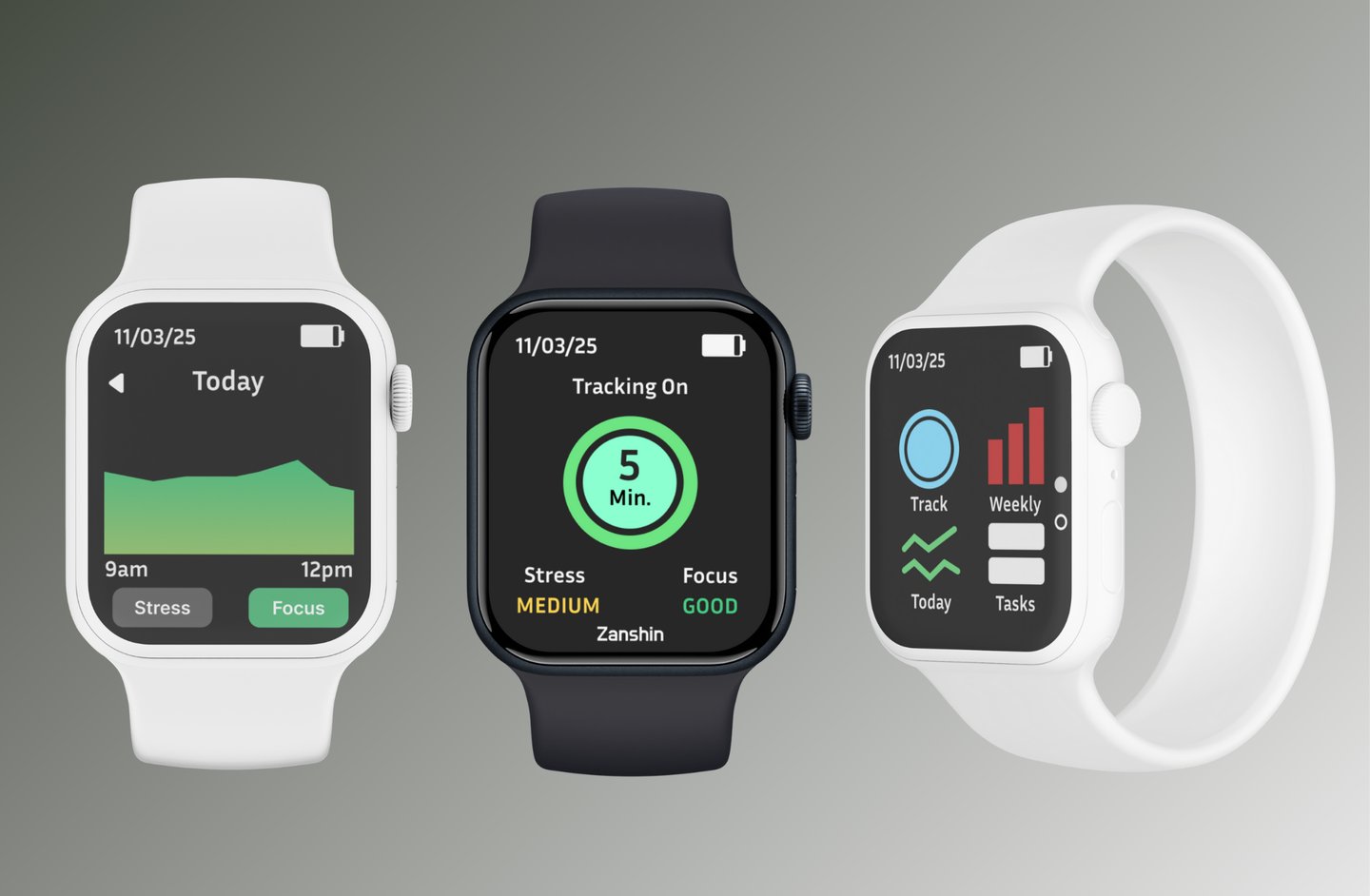
Zanshin is wearable stress and focus monitoring system supported by an intuitive companion interface designed to help users better manage their mental state and productivity. The wearable device continuously tracks indicators related to stress and cognitive engagement and translates this data into clear, easy-to-understand visual feedback within the interface. Users can quickly view their current stress and focus levels, receive timely notifications when stress increases or focus decreases, and access simple interventions such as breathing prompts or break reminders. This allows users to respond to changes in their mental state before stress negatively impacts their performance or well-being.
Problem Statement
Project Aim
This project aims to design and prototype a wearable productivity tracker that monitors stress and focus levels, providing real-time feedback to users. By integrating unobtrusive wearable technology with human centered design, this ensures an effective approach to address the need for holistic solutions that support a more focused, productive and balanced work life.
Introduction
The Double Diamond Method
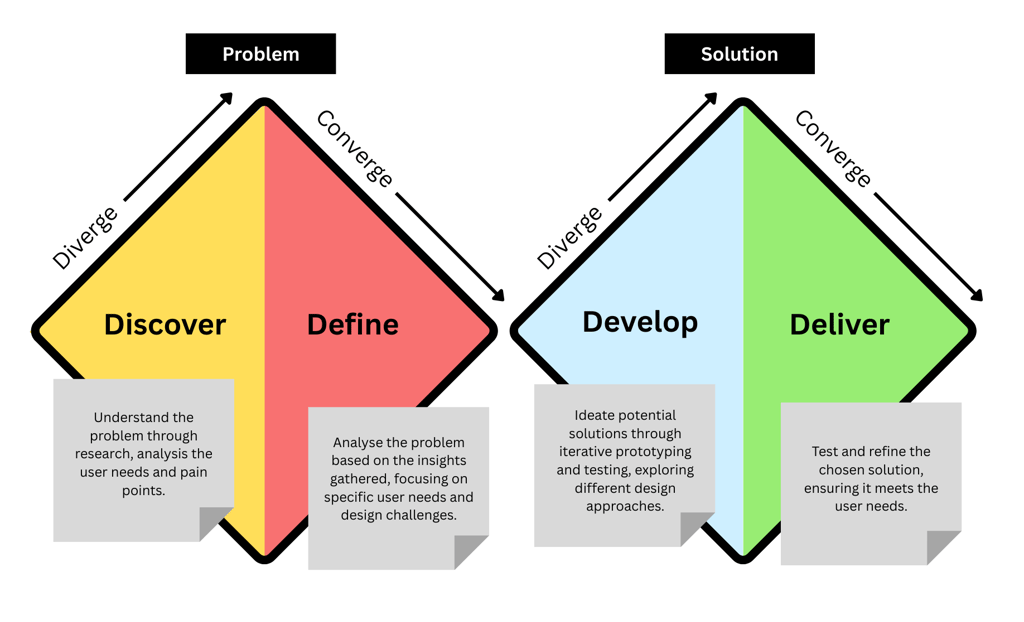
This project will adopt the Double Diamond framework as it provide designers to explore a wide range of possibilities before narrowing down to the best solution by encouraging multiple ideas and potential solutions, the process allows for great flexibility and creativity. This approach has been shown to save time in the design process and is applicable to both designers and non-designers.
Discover
SWOT Analysis
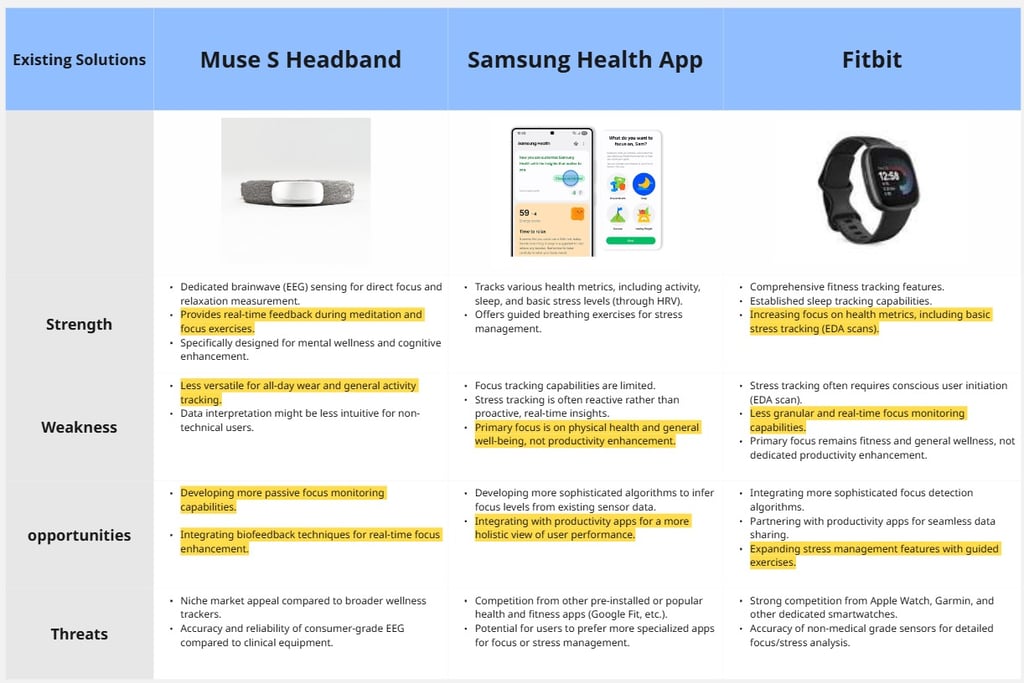
In order to develop a well-informed strategy that leverages the strengths and mitigates weaknesses, a SWOT analysis was carried out on existing products. SWOT analysis provides an insight of the competitive landscape, highlighting the strengths and weaknesses of existing products and identifying potential opportunities and threats to consider.
User Research
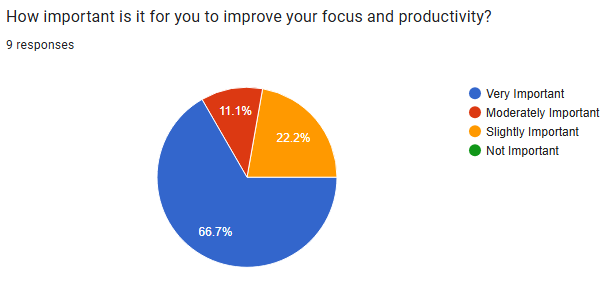
As part of the user centered design process, it is crucial to have a thorough understanding of the users for the product. Once the demographics of end users have been identified, this proceeds to a deeper exploration of user’s journey and pain points. From the previous researches it has been establish. A short survey was created attain data that may help to further understand real life users. Both quantitative and qualitative data were collected.
Persona Development
Analyzing the Themes
Storyboard
User Journey
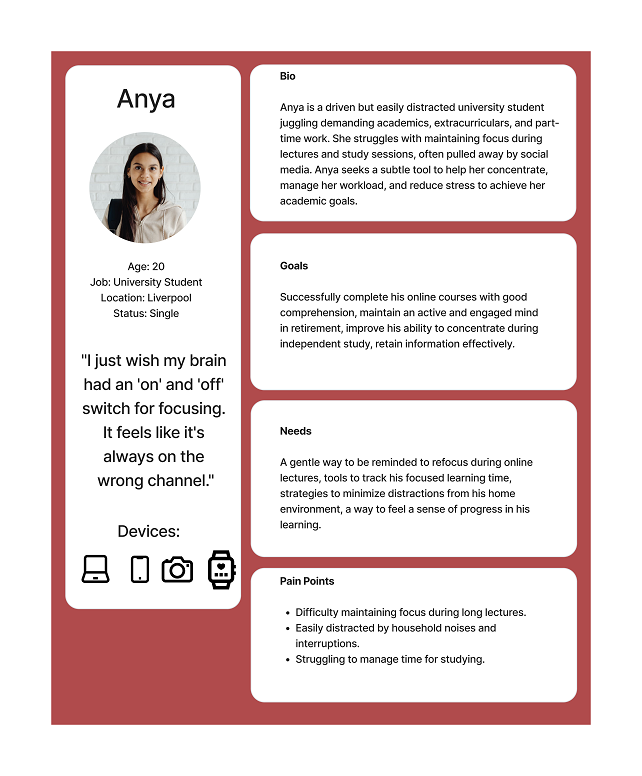
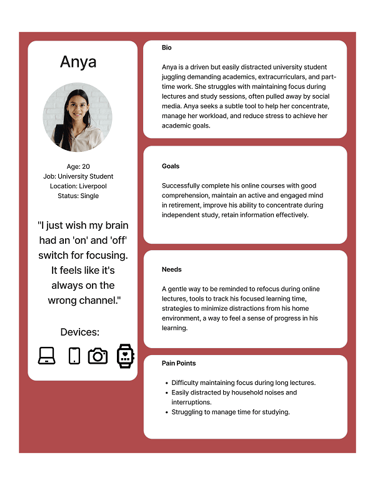
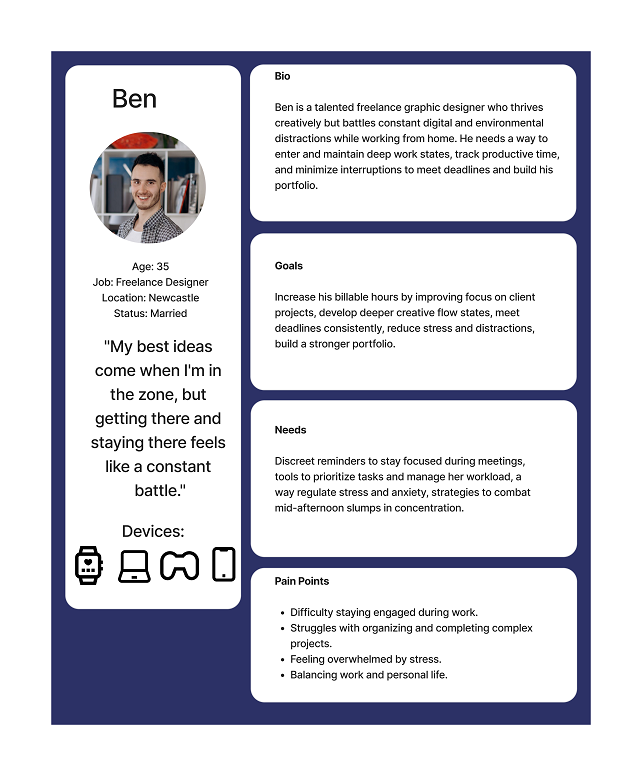
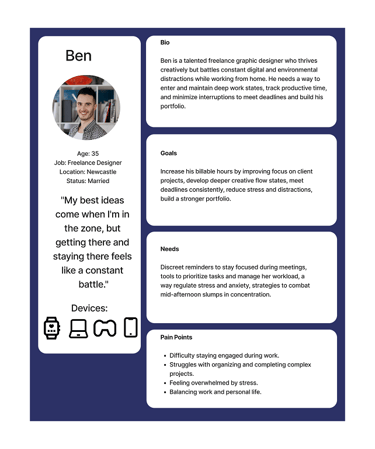
Based on the user research, three personas were created to help facilitate an in depth perspective of individual users. By focusing the needs, goals, and pain points of key user groups, it can ensure all design decisions are rooted in real-world context.
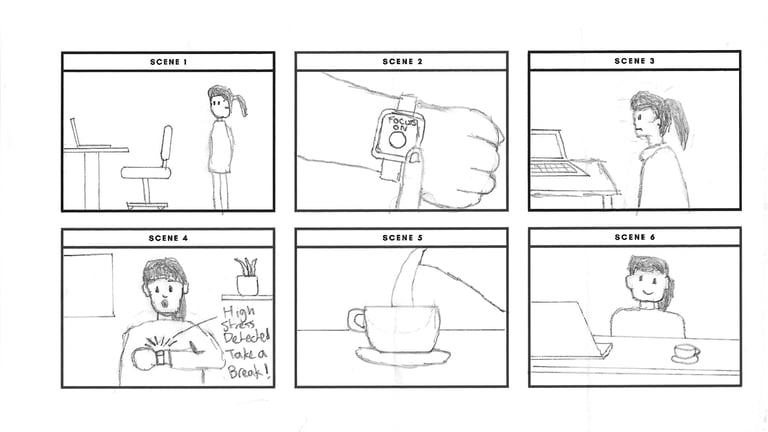
The storyboard showcase how Anya can use the device when studying through the following steps:
1. Anya is getting ready to study. She puts on the device.
2. She sits down at her desk, opens her textbook, and activates the device's focus mode.
3. She is deeply engrossed in her studies, completely focused on the material.
4. After a while, Anya starts to feel her focus slipping. The device gently vibrates, reminding her to take a short break.
5. Anya takes a few minutes to stretch, get a drink of water, or step outside for some fresh air. She uses this break to refresh her mind and come back to her studies with renewed focus.
6. She returns to her studies, feeling refreshed and energized. The device displays a summary of her focus session, showing her total focused time and any distractions.
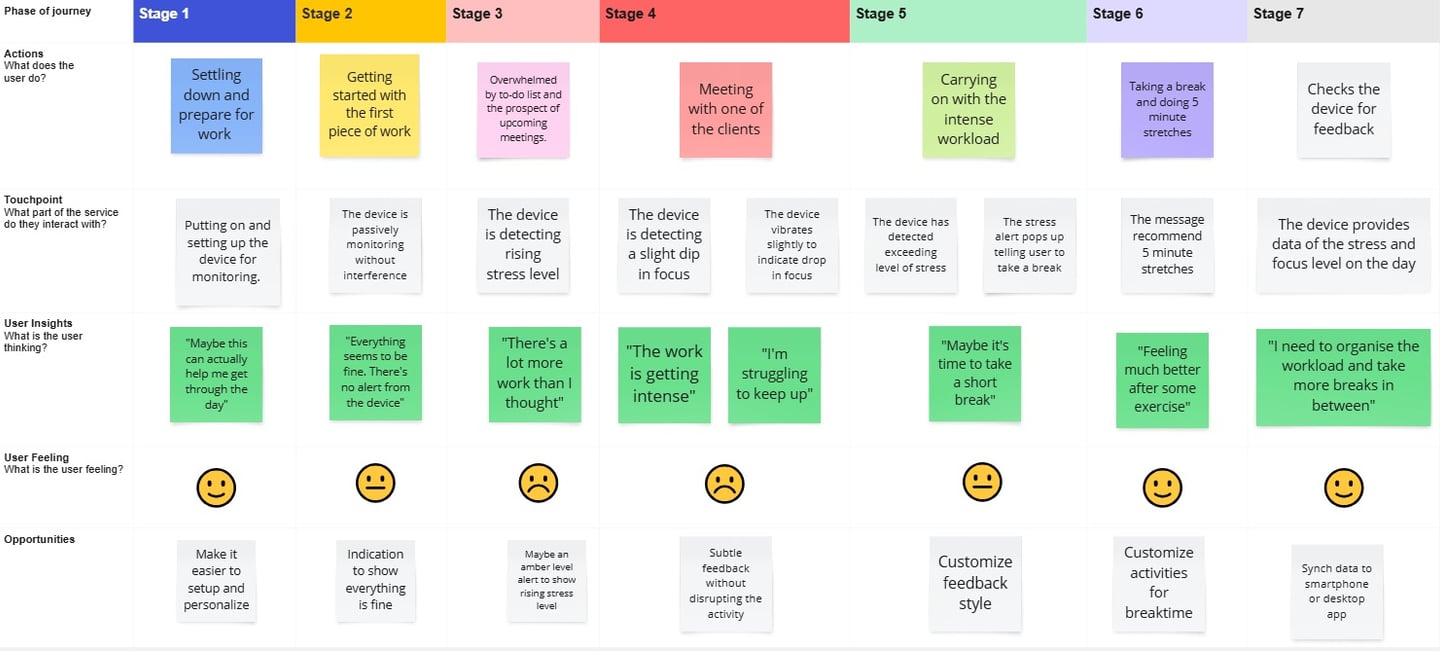
A user journey is incredibly effective for understanding users because it provides a holistic, step-by-step visualization of their experience as they interact with a product or try to achieve a goal. By mapping out the user's actions, thoughts, and feelings at each stage, we gain deep insights into their motivations, needs, and crucially, their pain points.
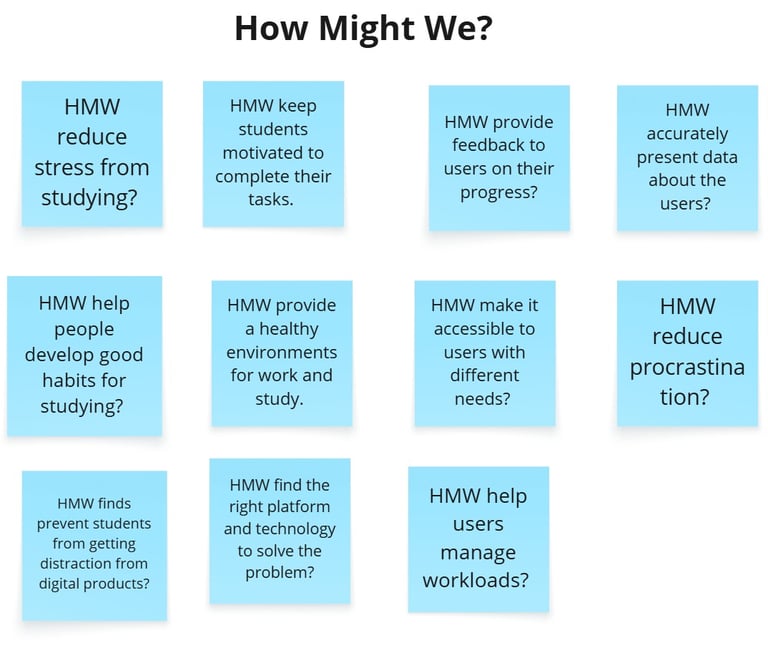
HMW questions helps frame design challenges as open-ended questions that encourage creative problem-solving. Based on the problems that has been highlighted this will guide the brainstorming sessions, ensuring an exploration of diverse avenues for enhancing focus, managing stress, and improving overall user experience, ultimately leading to a more impactful product.
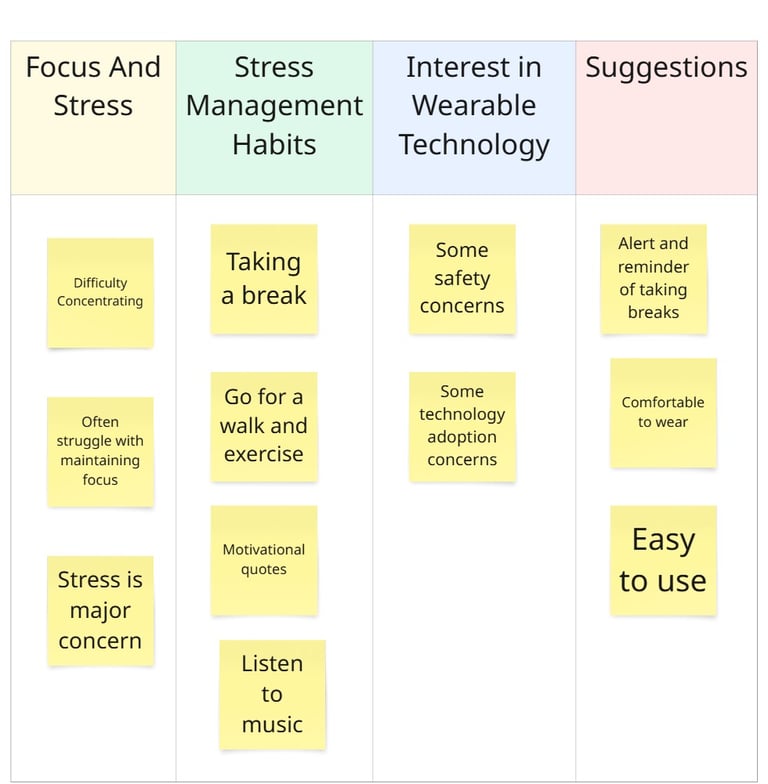
Following on from the survey, the result from the qualitative data has been arranged into themes in order to better understand the underlying experiences, perspectives, and needs of the target users regarding focus, productivity, stress and their expectations for a wearable solution.
For this project it has been useful in visualising user’s journeys and validating design concepts. Storyboarding is the process of visually representing a narrative or story using a sequence of panels.
Defining Problems
Mind Mapping
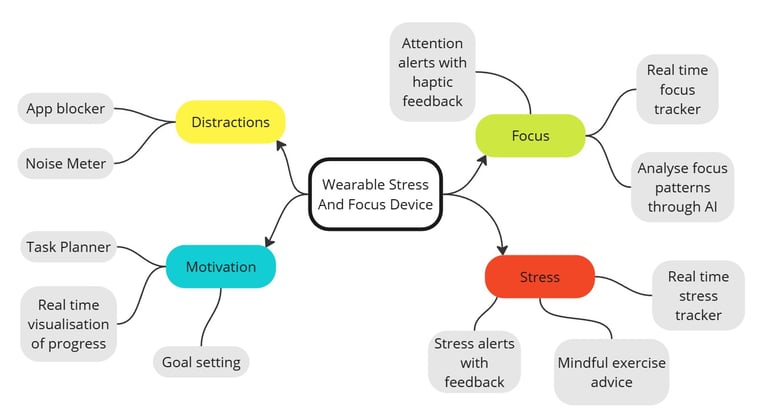
By visually organizing the diverse challenges related to focus, productivity, and stress identified through user research, it can establish a clear and interconnected understanding of the problem.
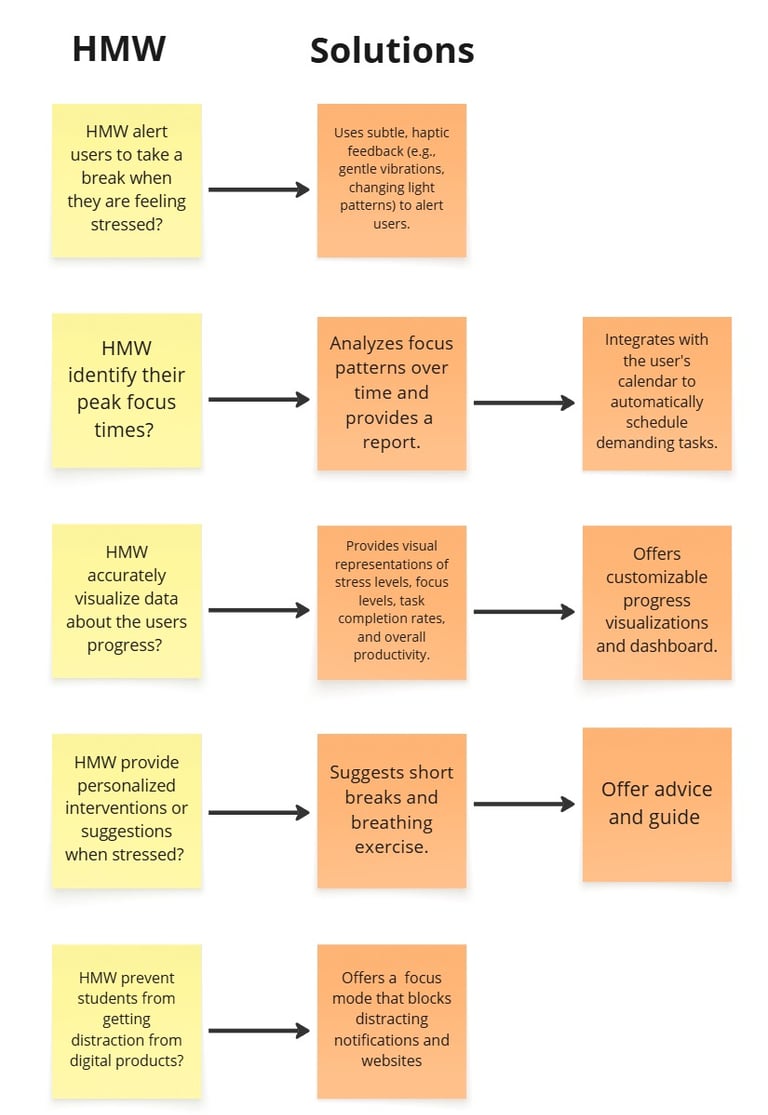
Finally the last phase of defining the problem is to find the solutions to the problem. The table represent how each How Might Wes has been matched with a solution. Some of the solutions has been expanded further to explore even more possibilities to resolve the problem. For example in ‘HMW personalize suggestions when stressed’, the initial solution provided is to ‘suggest short breaks and breathing exercise’, which then expended to ‘offer advice and guide’.
Develop
Crazy8
Wireframing
Low Fidelity Prototype
High-Fidelity Prototyping
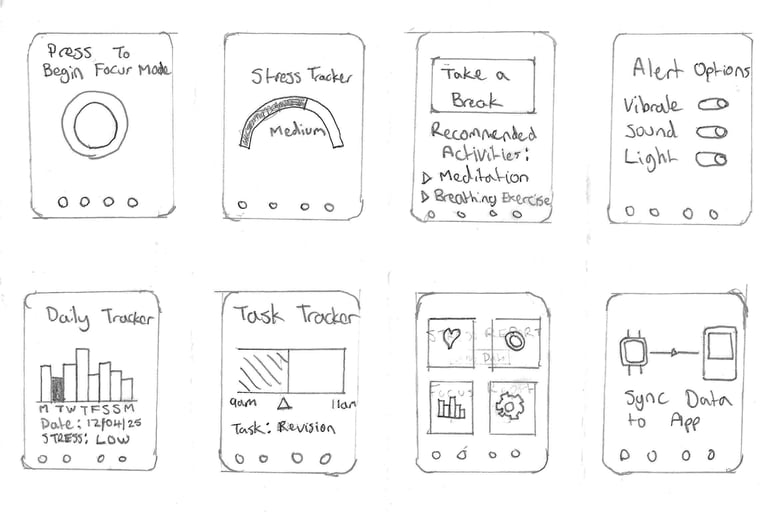
Crazy Eights can be particularly effective in generating diverse interface ideas for wearable device. The technique involves sketching eight ideas on an individual sheet of paper folded into eight panels. This is a rapid ideation technique often used in UX design to explore various ways to visualize features and interface design. The process was used to explore different interaction models for accessing quick actions, or approaches to presenting different functions.
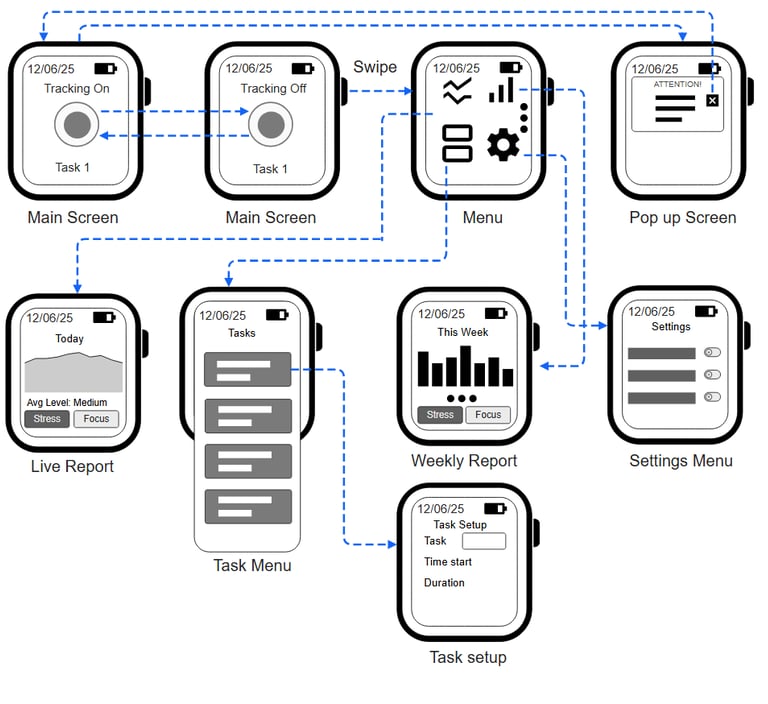
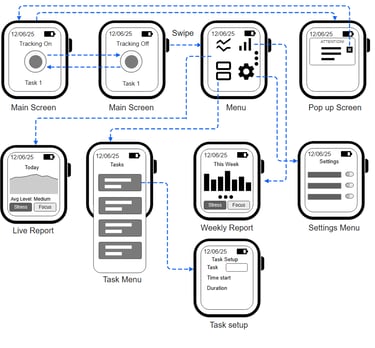
With the design and ideation laid out, this leads on to the wireframing of the prototype. Using the free software Moqup, this allow the the creation of the wireframe using just drag and drop design. Unlike the rough hand sketches such as the Crazy8, digital tools can produce a much cleaner and neater result.
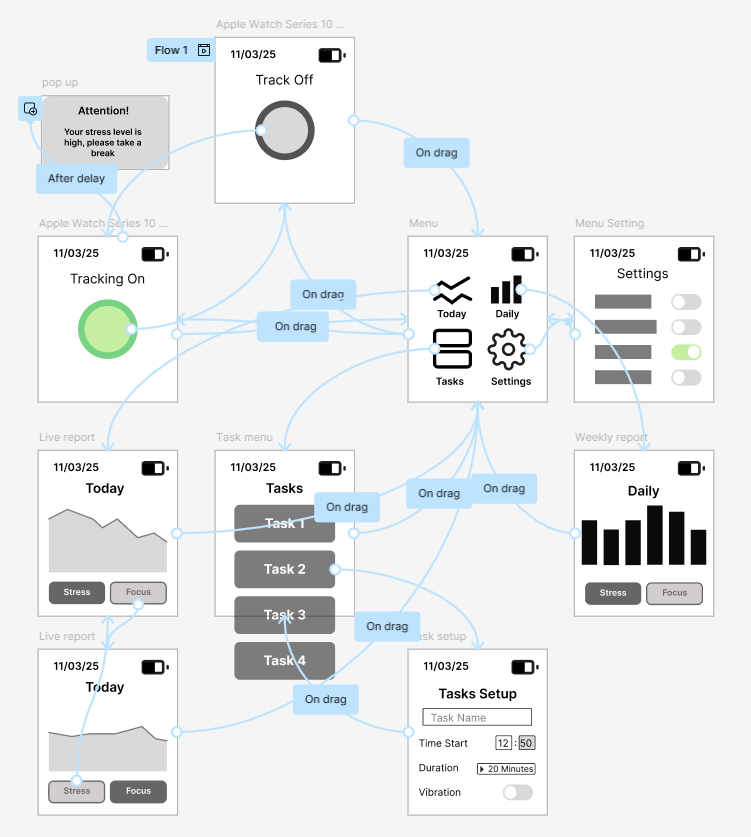
This is the first attempt into creating a functional prototype on Figma. The main focus is on the structure and flow of the user experience rather than visual aesthetics or detailed interactions. The digital prototype allows for real digital interaction of various different functions presented in the design.
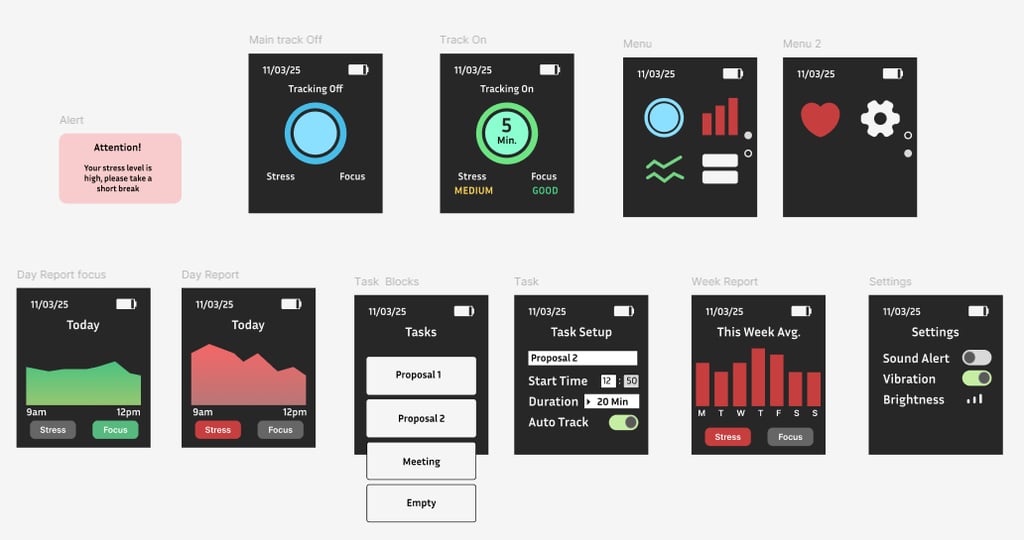
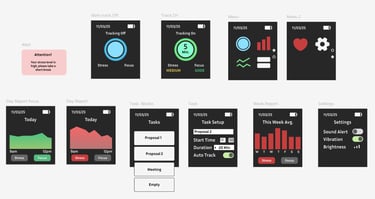
High-fidelity prototype represents a more detailed and interactive representations of the final product, just like the low-fidelity prototype, it was design on Figma. It closely mimic the visual design, interactions and the main functionality of the intended product as much as possible. The prototypes allow for more realistic user testing, enabling the evaluation of specific UI elements, visual appeal, and the overall user experience with a level of detail closer to the final product.
Deliver
Protoype Testing
Iteration & Refinement
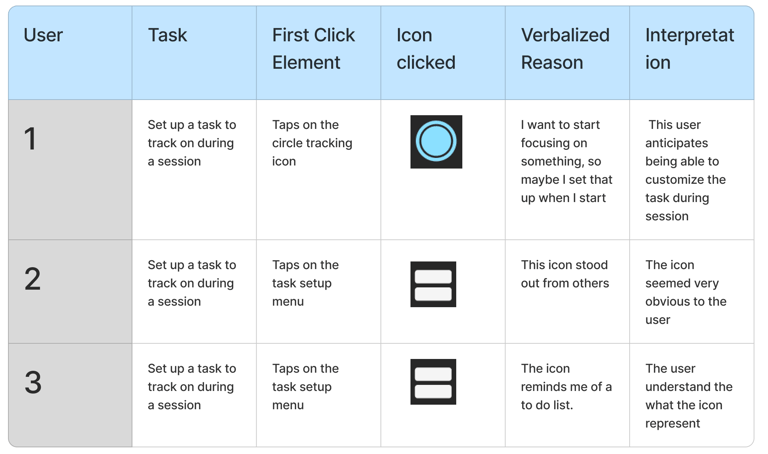
First Click Testing was used to test the high fidelity prototype, as it is an efficient method for gaining initial insights into the intuitiveness of the wearable interface. By observing where users instinctively tapped first when presented with a specific task, we quickly identified areas of potential confusion or alignment with user expectations
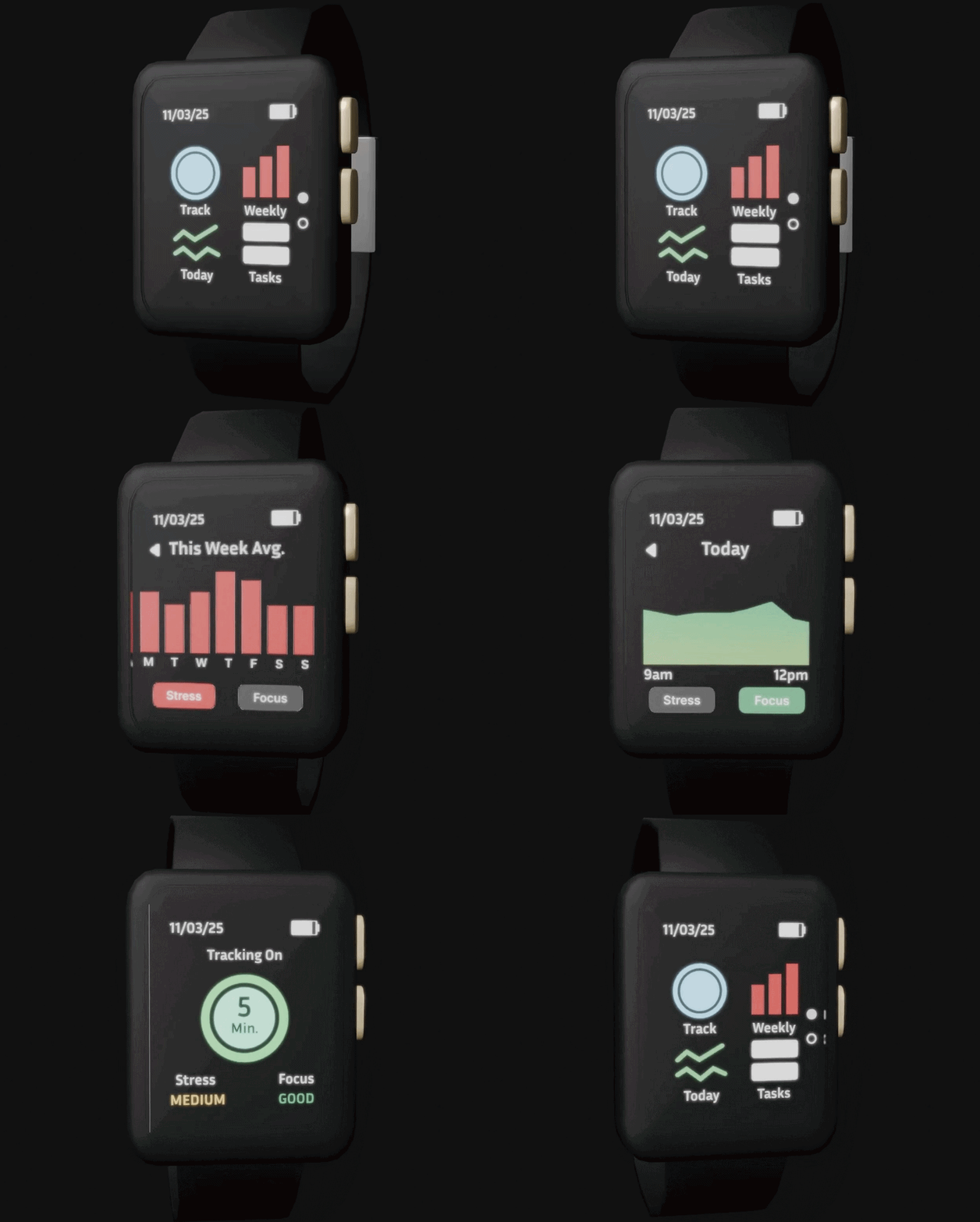
Based on the feedback from the test, some iterations are made to improve the user interface and to make the user flow much more simpler. In order to make the menu more understandable; texts has been placed underneath the icons to prevent misunderstandings of what they represent.
Conclusion
The project provides a compelling vision for a wearable solution that holistically addresses the intertwined challenges of focus and stress in the modern age. The Double Diamond process and the positive initial feedback from simulated testing suggest a genuine need and potential user acceptance for such a device. The integration of real-time feedback, personalized insights, and accessible stress management tools within a wearable format offers a tangible and proactive approach to empowering individuals to cultivate better focus habits, manage stress effectively, and ultimately enhance their productivity and well-being.
Contact
adee82@hotmail.co.uk
+447709042165
© 2026. All rights reserved.